
Orange County Previous Residents Sources
A backward search works when each source is assigned its own role. Deeds and assessment records follow ownership and land. Directories and census schedules show household snapshots. Sanborn sheets stabilize an old building and street number. Permits date a project, while newspapers, obituaries, and probate can connect a person to an event. The table keeps the local coverage honest. Orange County did not publish one complete annual directory for every city, and the Recorder’s public page does not state a first indexed year.
| Source | Years | Where Held | What It Shows |
|---|---|---|---|
| Recorder index and books | Current index; first online year not stated | Clerk-Recorder; Archives for older series | Owners, transfers, instruments, and legal descriptions |
| City and reverse directories | Varies by title and city | OCPL, municipal libraries, FamilySearch, licensed databases | Listed occupants, addresses, and sometimes occupations |
| Federal census | 1790-1950 public under the 72-year rule | NARA, library databases, Ancestry, FamilySearch | Household snapshot at enumeration |
| Santa Ana Sanborn maps | 1906-August 1949 | Library of Congress digitized volume | Building footprint, use, materials, and address context |
| Building permits | Varies by 34 cities and county territory | City department or OC Public Works | Project, applicant, contractor, dates, and status |
| Newspapers | Named titles 1919-2021; Register 1987-current | OCPL digital newspapers and NewsBank | Obituaries, notices, address events, and local names |
| Court and probate files | Late nineteenth century to present, subject to retention | Superior Court and Justice Centers | Petitions, heirs, disputes, and filed events |
Begin with the APN for a present parcel, a deed or directory for an older address, and the likely city or unincorporated jurisdiction for permits. A year, street number, and legal description are stronger anchors than a remembered household name.
Begin an Orange County Previous Residents Search
For a standing property, start with the situs address in the Orange County Assessor property and parcel-map route. The county directs users to ParcelQuest, and assessment information and property characteristics are available at the public counter at 500 S. Main Street, second floor, Orange. The Assessor main line is 714-834-2727, generally Monday through Friday from 8 a.m. to 5 p.m. Save the APN, parcel shape, assessee display, mailing clue, tract or lot detail, and legal-description clue.
Use the OC GIS parcel service to confirm geometry and nearby parcels, then check the Treasurer-Tax Collector secured-property-tax search when a tax status link helps. GIS and tax data can be date-stamped and updated on different cycles. The mailing address may belong to a trust, business, agent, post-office box, or another property, so it is a clue rather than proof that someone lived at the situs.
When the address has changed, keep both the current street form and the legal description. That pair makes the later deed search possible.
Note: The strongest previous-resident trail pairs an address with a dated source and records why each name belongs in the sequence.
Tracing Previous Residents Through Orange County Deeds
The Orange County Clerk-Recorder’s free grantor-grantee index is the main ownership trail, but it is an index only. Images are not exposed online, and staff do not conduct the name search for a user by phone, at the counter, or by mail. Search personally, save the grantor, grantee, recording date, instrument number, document type, and book or page reference, then use the identifier to request the document.
- Search the current owner or assessee in RecorderWorks and locate the acquisition instrument.
- Read the deed copy for grantor, grantee, recording date and number, vesting language, and legal description.
- Search the grantor as an earlier grantee, checking co-parties, dates, and the same parcel.
- Repeat the grantor-to-grantee loop until the index or document series no longer supports a match.
- Carry older references to the counter, mail-copy route, Archives, or a cataloged microfilm source rather than guessing a cutoff year.
- Grantor and grantee
- The grantor transfers an interest; the grantee receives it in the recorded instrument.
- Chain of title
- The linked sequence of recorded transfers used to trace ownership backward or forward.
- Legal description
- The parcel description that identifies land independently of a postal street number.
The established copy route uses a request, payment, and self-addressed stamped envelope sent to 601 N. Ross Street, Santa Ana, CA 92701. The published charge is $1 per page plus $1 certification per document or map. The Clerk-Recorder phone, 714-834-2500, answers procedure questions but does not perform the search. A focused CPRA request may seek an identifiable existing administrative record, but the paid copy process is the correct route for a specific recorded instrument.
Libraries, the Orange County Archives, California State Archives catalogs, and FamilySearch can help locate maps, directories, or microfilm that improves the name and date query. They do not replace the recorded document.
Previous Residents Across Orange County’s 1982 Shift
One Orange County research quirk is the change in the document identifier convention. Documents before 1982 use book, page, and instrument number when available. Documents from 1982 forward use the recording year plus a six-digit instrument number. That is a retrieval convention, not proof that Orange County’s online index begins in 1982.
Use the format that belongs to the record. A pre-1982 book and page can be the bridge to a deed book or older archive series. A 1982-forward number can lead back to the digital index and then to a copy request. Preserve leading zeroes and punctuation as displayed, and check both spouses, co-owners, trusts, and entity variants when a common name produces several results.
The legal description matters more than a postal label when the street was renamed, annexed, or renumbered. It is the stable bridge between the current parcel and past occupants attached to older documents.
Note: The identifier cutover explains how to request a record, not how long the county has kept every record series.
Previous Residents in Orange County Directories
Owners are only one layer of previous residents. City and reverse directories may list a householder or telephone subscriber at an address, while a census records a household on an enumeration date. A blank directory year can mean omission, relocation, death, a publication gap, or coverage outside that publisher’s area. The collection details belong with the Orange County city directory collections, but the backward trail needs a simple pairing method.
OC Public Libraries supplies a useful access chain. Ancestry Library Edition requires a full-privileges card and in-branch use. HeritageQuest and Fold3 provide other licensed paths, and OCPL digital newspapers are also in-library resources. Users can view, print, or download where the collection permits. Named local newspaper runs include Coastline Dispatch San Juan Capistrano from 1931-1968, Laguna titles from 1919-1989, and San Clemente Sun-Post from 1937-2021. The Orange County Register is available in NewsBank from 1987-current.
Pair the records in order:
- Copy the exact name, street number, street spelling, and directory year.
- Check the same address in the nearest directory years and use a reverse section when present.
- Compare the household with the public federal census years through 1950, keeping the 72-year cutoff in view.
- Use deeds to separate owners from listed occupants and permits to date a physical change.
- Search newspapers, an obituary, or probate when a household leaves the address.
This sequence shows continuity and gaps without claiming that every person in a household appeared in a directory.
Orange County Sanborn Sheets for Previous Residents
Old Santa Ana addresses have a useful map bridge. The digitized Santa Ana Sanborn volume contains 64 sheets covering 1906 through August 1949. A Sanborn sheet can show a building footprint, materials, use, and street-number context. It does not name every occupant, so pair it with a directory entry, deed, census household, or newspaper notice.
For a previous-residents search, compare the map’s footprint and number with the directory’s street section. If the building shape or number changes, keep the legal description and APN in the record note. This is especially useful in older downtown grids, where a remembered number can look stable while the parcel or address convention has shifted.
Library and archive access adds context when a map is not enough. A map dates a place and structure. A directory dates a listed person. A deed dates a transfer. Their limits are different by design.
Note: A Sanborn map can show a building's historical footprint, while a deed or directory supplies the people and dates to compare.
Orange County Permits Across Jurisdictions
Permit and code records can date construction or a remodel, but Orange County has 34 incorporated cities and unincorporated territory. The relevant city building or planning department keeps city records. OC Public Works covers unincorporated land. There is no single countywide permit system that can be named for every address.
A permit may show the parcel, applicant, contractor, project description, valuation, dates, and status. The applicant can be an owner, architect, or contractor rather than a resident. Code cases can contain inspection dates or alleged conditions, while personal contact details and active-investigation material may be withheld. Use the parcel jurisdiction first, then the city portal, counter, email, or CPRA request documented by that custodian.
For older work, a focused request should name the address, APN, permit or project type, and date range. A local permit file can explain why a directory address changed, but it cannot prove that the applicant lived there.
Orange County Vital Records for Households
Vital records can anchor a former household when the event and relationship are known. California uses authorized and informational certified-copy rules under Health and Safety Code sections 103525 and 103526. Confidential marriage records have no ordinary informational-copy route. Divorce decrees come from Superior Court. County and state channels offer online application information, in-person service, mail requests, and phone help. Pre-July 1905 research may need churches, missions, cemeteries, newspapers, county records, or archives.
The 2026 California vital-record fee page lists $31 for a birth copy, $26 for a death copy, $19 for a marriage copy, and $18 for a dissolution certificate. These numbers help date a current request, not a historical event.
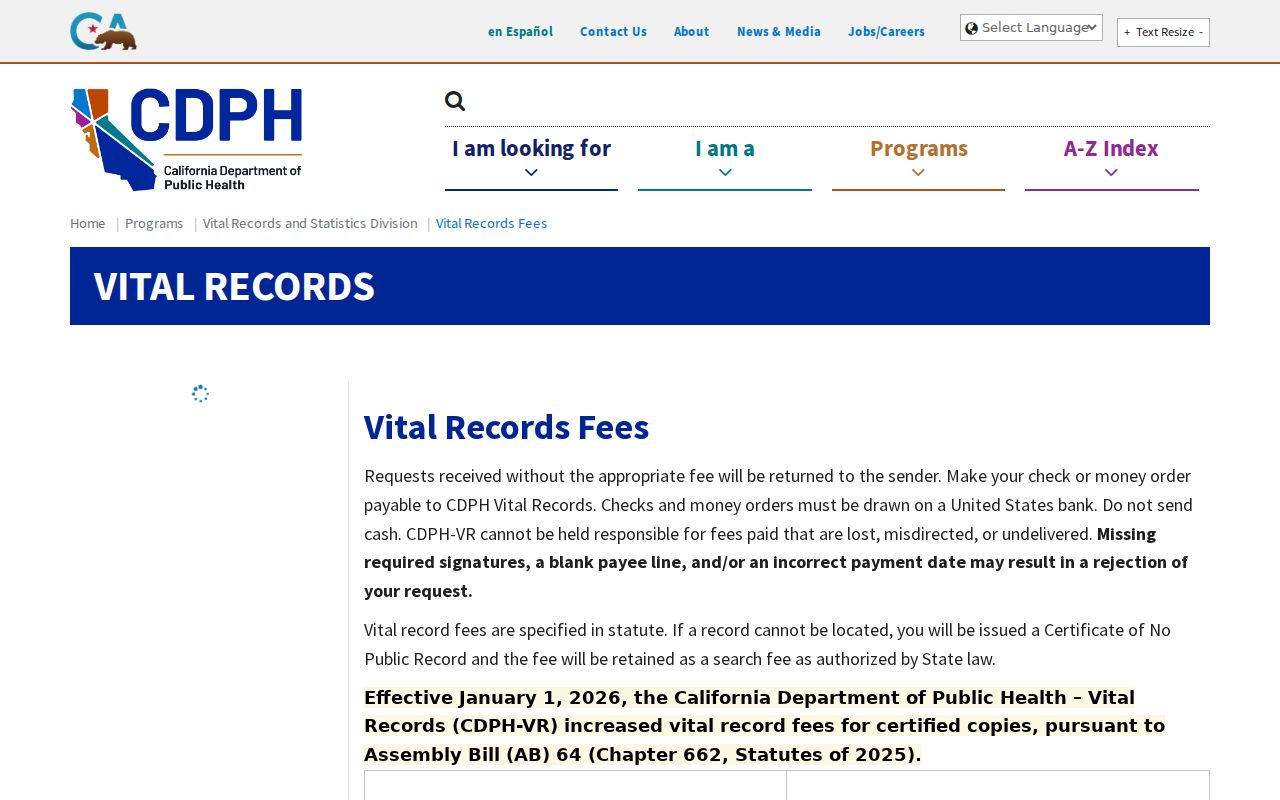
The fee-page image belongs beside the vital-record endpoint because a former resident’s certificate request has a different access rule from a deed or directory search. An authorized mail request needs the applicable form and notarized sworn statement.
Adoption originals and original birth certificates remain sealed absent the lawful contact or court process. A previous-residents trail should stop at that boundary and use the official adoption-information routes instead of treating a sealed record as a public index.
Pre-1889 Orange County Record Trails
Orange County was formed from Los Angeles County in 1889, with Santa Ana as county seat. An 1880 household or deed connected to today’s Orange County may therefore appear under Los Angeles County or a predecessor jurisdiction. Search place names, rancho or subdivision labels, and parent-county catalogs before deciding that a person or parcel is missing.
Superior Court guidance reaches the late nineteenth century, but the court says records date to 1898 while civil instructions describe searches from 1889. Retention varies, older indexes may sit at the correct Justice Center, and remote access is newer than the underlying record. For probate, use Case Access or the court name route, visit the correct Justice Center when needed, and use Form L-3009 with a case number, party role, document, date, contact details, and payment. Sealed, juvenile, adoption, and confidential family material remains restricted.
Mail, email, counter review, and off-site retrieval are all part of the court channel. A photo ID deposit can apply to a non-imaged file, and older files may take days. Obituaries and probate can reconnect an heir to a former address, but the court file and source newspaper should be checked together.
Note: A pre-1889 catalog label is a geography clue, not evidence that every later Orange County record was stored in Los Angeles County.
Lawful Limits on Orange County Previous Residents
Previous-resident research can serve family history, a house history, an estate, or a search for a deceased relative. It cannot turn an owner into an occupant or a directory gap into proof that no one lived there. Non-owner household members, utility customers, protected voters, and confidential participants may never appear in a public record. A deed’s recording date also differs from the date it was signed or when someone moved.
Use the smallest set of names and dates needed for the question. Preserve source, edition, page, APN, and legal-description notes. Verify with the office that holds the record before repeating a match, and stop when a request would expose a protected person or invite unwanted contact.
House-history use. Orange County previous-residents research is for lawful personal history and record work. Do not use a deed chain, directory entry, obituary, or map to stalk, harass, threaten, or track a living person.