
Orange County Resident Lookup Sources
Orange County has no single residents roll. A useful resident lookup starts by matching the record to the question. The property roll can connect an owner or assessee to a parcel, while a recorded instrument names parties to a transaction. Voter data has a separate access rule. Court records identify parties and case events, not a current home. Vital records prove an event under copy rules. Business, license, and unclaimed-property entries show a filing or affiliation. Each result is a clue with a custodian, date, and boundary.
| Record | What It Confirms | Where to Search | Access |
|---|---|---|---|
| Assessor / parcel | APN, situs, assessment, and mailing clues | Orange County Assessor | Web route or public counter |
| Recorded documents | Grantors, grantees, instrument dates, and legal descriptions | RecorderWorks | Free index; copy process for images |
| Voter self / authorized data | Own status, or approved-file residence and status fields | California voter tools and OC Vote | Self-lookup or Elections Code purpose |
| Court | Party role, case type, dates, hearings, and available documents | Orange County Superior Court | Remote, Justice Center, or request |
| Vital | Birth, death, marriage, or divorce event evidence | County Clerk-Recorder, CDPH, or Superior Court | Authorized or informational rules |
| Business / FBN | Entity, assumed-name, agent, or filing address | Clerk-Recorder and Secretary of State | Filing access; not residence proof |
| Professional license | License identity, status, dates, and discipline links | California DCA and boards | Free public lookup |
| Unclaimed property | Name, reporting holder, and property clue | State Controller index | Free search; proof needed to claim |
Use an address or parcel first when the name is common. Use a court, vital, license, or entity path when the event or filing is known. An owner name is not an occupant list, and a court party is not a current resident. The office that created the record is the place to verify a match.
Separate Roles in Orange County Records
A resident lookup becomes safer when each label is read literally. The Assessor describes an assessed parcel and may show an assessee or mailing address. The situs is the physical property. A mailing address may belong to a trust, business, agent, post-office box, or another property. RecorderWorks is a grantor-grantee index, so it shows a named party and identifier, while the deed copy supplies the legal description and other document detail. Neither source alone states who occupies a home.
Business and license records also need care. A Secretary of State bizfile entity entry, county fictitious business name filing, or DCA license can connect a person to an organization or credential at a point in time. The address may be a service or business address. A State Controller unclaimed-property result is a lead that still needs a claim review. These distinctions keep a one-person search from turning a filing contact into an unsupported identity match.
Access differs by record. The Assessor’s online route goes through ParcelQuest, with assessment information and property characteristics also available at the public counter at 500 S. Main Street, second floor, Orange. The main line is 714-834-2727, generally Monday through Friday from 8 a.m. to 5 p.m. RecorderWorks is an online index only. Staff do not search for users by phone, mail, or at the counter; bring a saved identifier in person or send a copy request to 601 N. Ross Street, Santa Ana, CA 92701. The published recorded-copy charge is $1 per page plus $1 certification per document or map. The Clerk-Recorder phone, 714-834-2500, answers procedure questions. Libraries and archives can supply context, while CPRA requests are for identifiable existing records, not a new person list.
The records commonly return different fields, so save the source and date with every result.
- A parcel result can show APN, situs, assessment information, characteristics, and a mailing clue.
- A recorded-document index can show grantor, grantee, recording date, instrument number, document type, and book or page reference.
- A court result can show case number, caption, party role, filing date, status, hearings, and eligible documents.
- A vital application asks for the event, relationship, copy type, and requester information under the form rules.
- A license or entity search shows affiliation, status, or filing evidence rather than a full household.
Orange County Voter Records
California My Voter Status is the online self-lookup route. A voter checks their own status and election information; it is not a public name directory. A broader voter-file request follows the county and state process under Elections Code section 2194 and 2 CCR sections 19001 through 19013. The statewide PVRDR route and the Orange County application require an approved purpose rather than casual interest in a block or person.
The OC Vote voter-data application uses a wet original signature, payment, and supporting material. A mail order includes a photocopy of official photo identification. The file can be picked up or shipped for a fee under the application instructions. In-person and mail service is tied to the Registrar of Voters at 1300 S. Grand Avenue, Building C, Santa Ana, CA 92705. A general CPRA request cannot bypass the specific voter-confidentiality statute.
Safe at Home can keep qualifying participants confidential across these channels. Treat a self-lookup, authorized file, and historical library or archive item as separate record types with separate limits.
Note: Orange County voter lookup is designed for an individual to view their own registration, subject to the statutory access limits.
Orange County Court Records
The Orange County Superior Court Case Access hub separates Civil, Criminal/Traffic, Family, Probate, and Small Claims routes. Case Name Search requires free enrollment. The search can find a party or business, but remote coverage is not the same as a complete courthouse file. Court records reach the late nineteenth century in the published guidance, yet retention varies by case type. Older indexes and files may be held at the appropriate Justice Center.
| Route | Useful result | Limit to keep in mind |
|---|---|---|
| Case Access | Case category, number, register, dates, parties, and events | Remote summaries and documents vary |
| Case Name Search | Party-name and business-name case leads | Free enrollment; payment may apply |
| Justice Center index | Older or locally held index and file retrieval | Correct center required; off-site files take days |
| Federal PACER | Central District civil, criminal, and bankruptcy cases | Federal litigation is not residence proof |
The court’s own description is the right way to read a result. Compare the party role, filing year, case type, middle name or initial, and any lawfully visible address clue. A shared name by itself is not a verification.
The Orange County Case Name Search landing page is the party-name route. Enrollment is free, but an account does not expand sealed records or turn a party hit into proof of current residence.
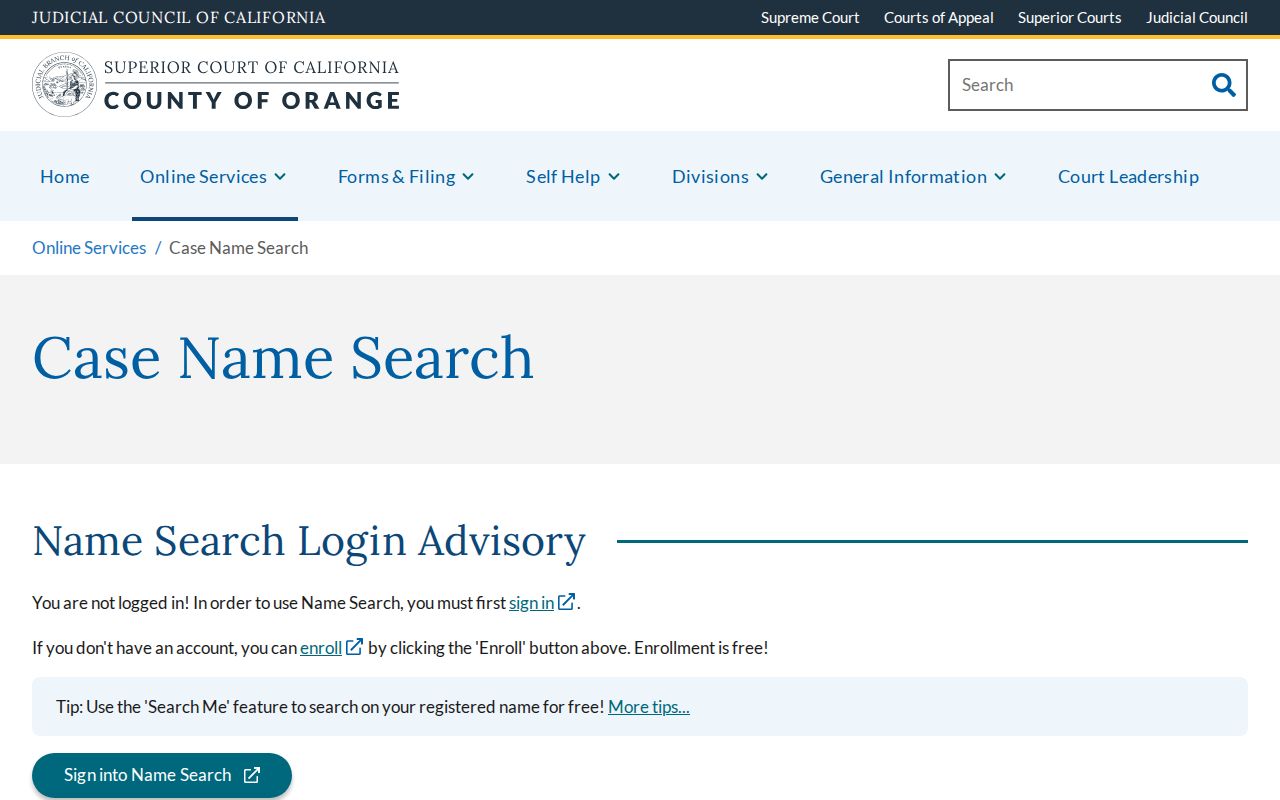
The case-name search image shows the separate account step that sits between a person’s name and the court’s result set.
Federal cases belong in PACER’s official access system. The federal search and document path is separate from Orange County Superior Court, and PACER results still describe a case rather than a person’s present location.
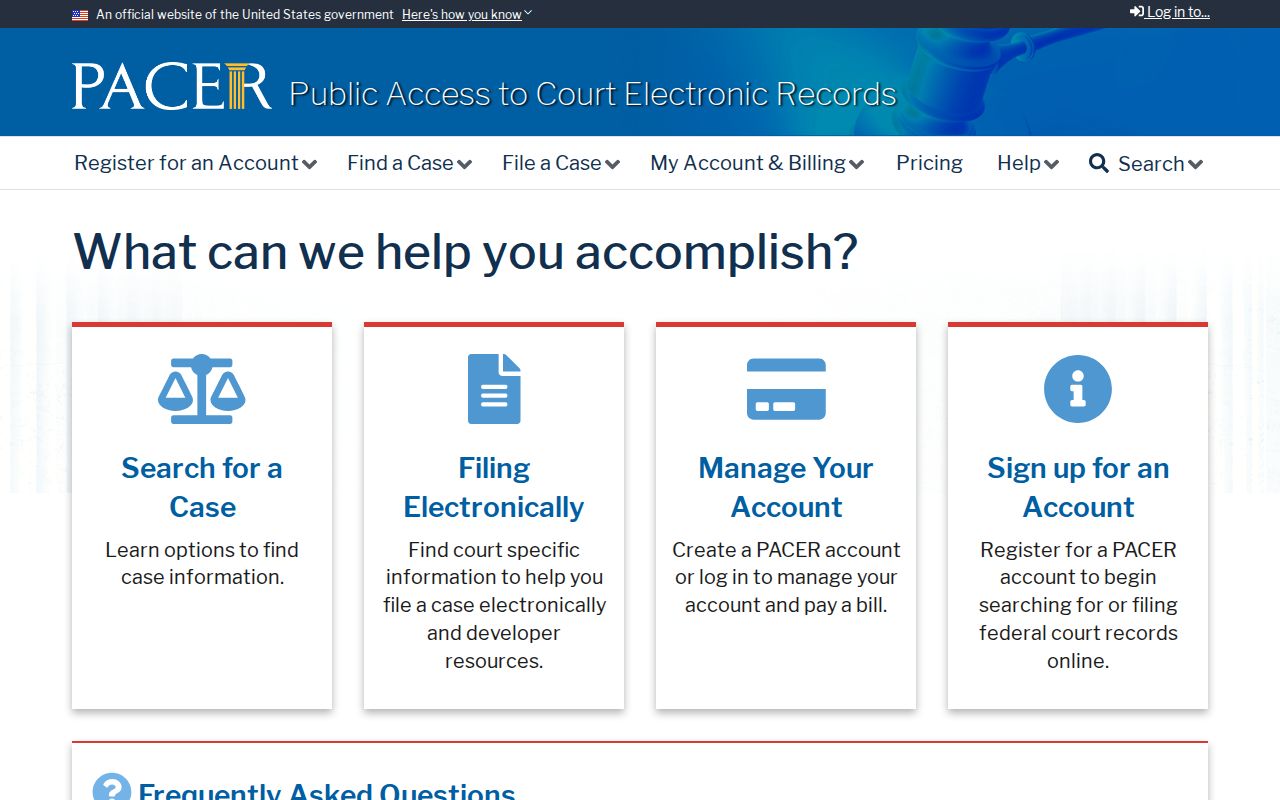
The PACER access view is useful when a name search moves outside the county court system, but the case caption and date still need identity controls.
Orange County Civil File Lookup
The Orange County Superior Court records overview distinguishes historical holdings from material that can be viewed online. Public remote civil summaries cover unlimited and complex matters from 1996 and limited civil matters from 2005. Most civil documents filed on or after January 1, 2008 may be available remotely, with fees for eligible documents. The remote display is not the official record.
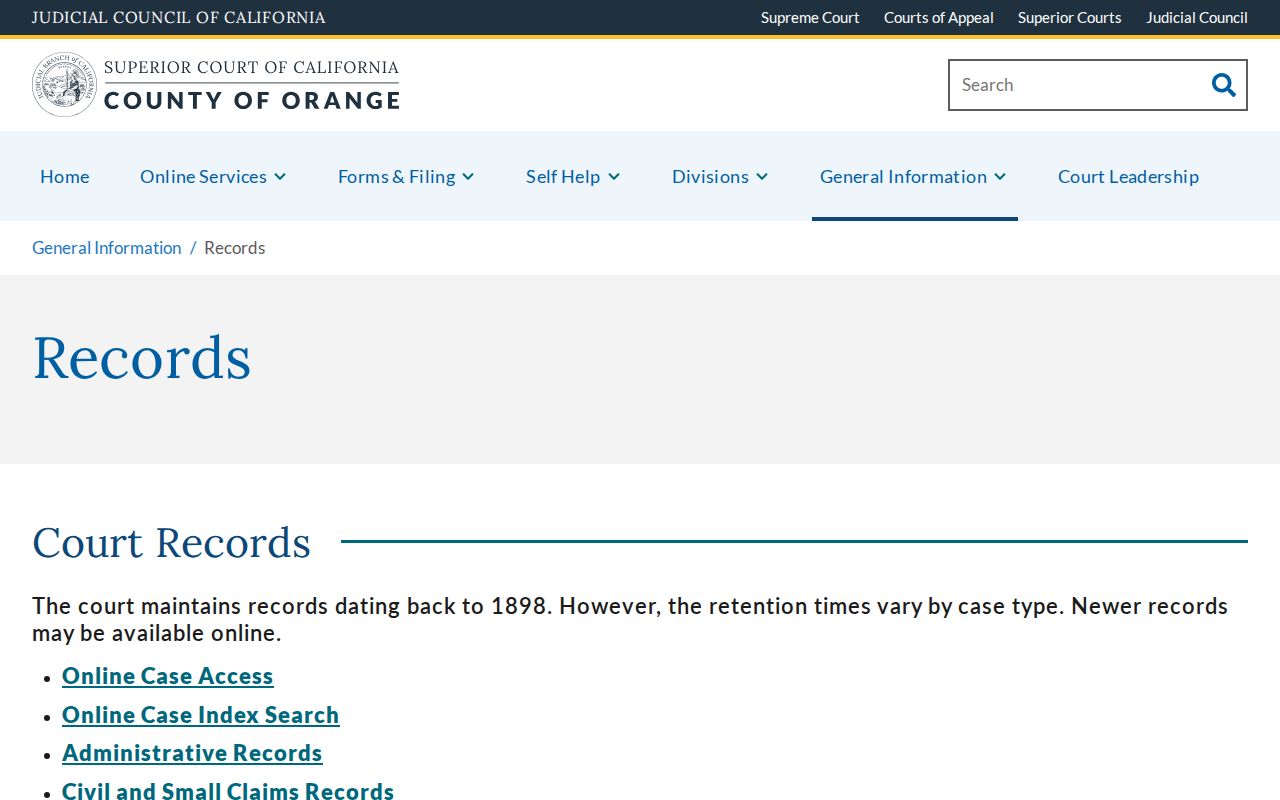
The court records overview image shows why a resident lookup should move to the Justice Center when an older index or non-imaged file is needed. A photo ID deposit is required to view a non-imaged file, and an off-site file may take several days to arrive.
For a civil copy, the court’s L-3009 request instructions call for specific retrieval details. Include the case number when known, plaintiff or petitioner, defendant or respondent, the requested document, filing date, requester contact details, delivery choice, and payment information. Mail requests need a 9-by-12 self-addressed stamped envelope. Civil copies cost $0.50 per page, certification is $40 per document, and exemplification is $50.
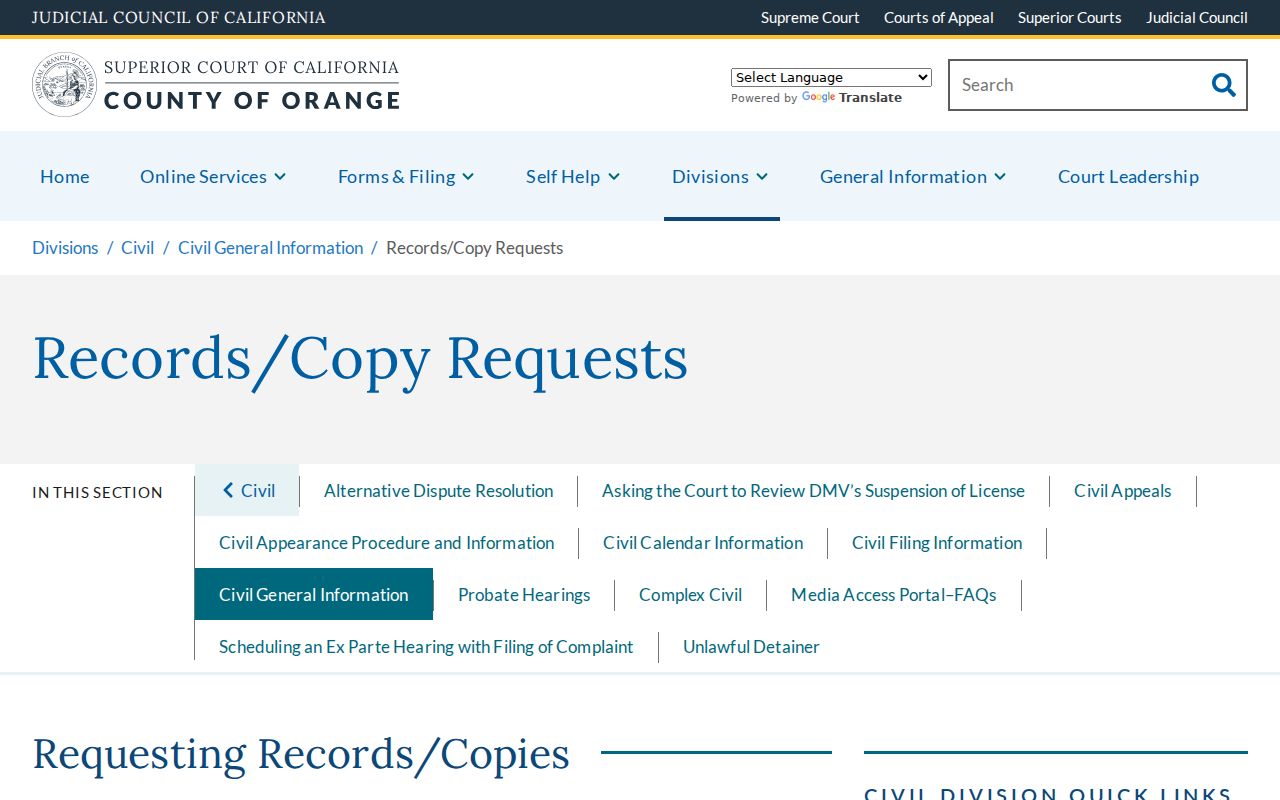
The civil copy-request image is a reminder that an index hit and a certified paper copy are separate steps. Criminal requests add the defendant’s date of birth and driver-license number if known, the exact documents, and a contact number. The published criminal turnaround is 7 to 10 working days, and an unknown total may be capped at not more than $25.
Online search, Justice Center review, and mail, email, or counter requests serve different needs. Sealed, juvenile, adoption, and confidential family or criminal material stays restricted through every channel.
Orange County Vital Records
California does not use one universal closure period for vital records. Health and Safety Code sections 103525 and 103526 separate authorized certified copies from informational certified copies. An authorized requester must fit a statutory category and provide the required sworn statement. Other requesters may generally seek an informational copy, but confidential marriage records are restricted to the parties or a court or statutory route. The Orange County Clerk-Recorder handles county events, while CDPH maintains its statewide series. Divorce decrees come from Superior Court, not the Clerk-Recorder.
The 2026 CDPH fee schedule lists birth copies at $31, death copies at $26, marriage copies at $19, and dissolution certificates at $18. CDPH birth records in its series reach back to July 1905. A mail request uses the current form, payment, and, for an authorized copy, a notarized sworn statement. The county and CDPH provide online application information, in-person service, mail routes, and phone help. The county number is 714-834-2500; CDPH public information is 916-558-1784.
| Event | Custodian path | Copy point |
|---|---|---|
| Birth | County Clerk-Recorder or CDPH | Authorized or informational; CDPH series from July 1905 |
| Death | County Clerk-Recorder or CDPH | Authorized and informational rules apply |
| Public marriage | County Clerk-Recorder or CDPH | An index does not prove current marital status |
| Confidential marriage | County of issuance | No ordinary informational-copy route |
| Divorce | Orange County Superior Court | Decree or file is a court record |
The VS 111 birth application asks for the applicant’s name, address, phone, number of copies, registrant’s full name, date and place of birth, parent names, relationship, purpose, signature, and copy type. Pre-July 1905 research moves to county or state archives, churches, missions, cemeteries, newspapers, and genealogy collections. Adoption originals remain sealed absent the lawful contact or court process.
Note: A vital-record copy proves what the custodian certifies for that event; it does not by itself establish a current Orange County address.
Orange County Identity Lookup
Orange County had 3,186,989 people in the 2020 Census. At county scale, a common name needs more than one matching field. Preserve the exact spelling, middle initial, suffix, compound surname, diacritic variant, and name order. Keep the case date, party role, co-parties, parcel or legal description, license or entity number, and city with the result. Record dates matter because a mailing address, tax lien date, case filing, or license status is tied to a point in time.
A practical one-person check can move from a broad clue to a narrow source:
- Anchor the name to a parcel, city, date, co-party, or known event using a lawful record.
- Search the court party index with spelling variants and the relevant case type or year.
- Compare the party role and location clue with a deed, license, entity filing, or vital event.
- Use a second independent record before treating two entries as one resident.
- Order a certified or plain copy from the custodian when the source itself must be read.
- Docket
- The court’s organized case record, including filings, events, hearings, and entries.
- Index versus image
- An index points to a record and identifier; an image or copy shows the filed document itself.
- Certified copy
- A copy authenticated by the custodian for an accepted purpose; certification does not prove every statement inside the document.
Do not ask a clerk to authenticate a personal identity by phone. Ask how to retrieve the record, then let the record’s own fields do the work. California’s 2026 approval of listed diacritical marks on vital certificates also makes marked and unmarked name variants worth checking.
Note: A date-stamped source, co-party, parcel, or case role is stronger than a bare name match in a county of this scale.
Orange County Family Records
Probate is a focused path when the goal is to reconnect an heir with an old address or estate. Search the decedent and case type through the Superior Court, then review the petition, notices, and filed material that the court makes available. Probate can connect names, dates, and relationships, but access still varies by file and sealed material. The court, not a general county index, controls the case.
For a former classmate, OC Public Libraries and local collections can supply yearbooks, newspapers, or community histories. For a birth-family connection, California’s official adoption-information channels, mutual consent and contact-preference processes, and a court petition are the lawful routes. Original adoption records and original birth certificates remain sealed unless the applicable statute or court process opens them. A public resident lookup cannot replace that process.
Obituaries, cemetery entries, and probate notices can close a family trail, but they are leads. Compare the name, place, date, and relatives against the record custodian before treating a notice as proof.
Orange County Business Records
Business and professional searches help when the known fact is a filing or credential rather than a street address. Secretary of State entity results can show a name or number, status, jurisdiction, agent, address, and filing history as available. Orange County fictitious business name filings add an assumed-name and registrant trail. A registered agent, contractor, or licensee address is a filing contact, not automatic proof of a home.
California’s DCA search can show a license name, type or number, status, issue and expiration information, and discipline links. Separate boards may add fields. Online access is the normal first route. For older or non-digitized filings, ask the exact county or state custodian for a filed statement or list. Do not ask an agency to transform business records into a residence investigation.
Unclaimed-property searching is a separate name lead. The result identifies a reporting holder or property clue, while a claim requires proof. Search aliases and entity forms, then preserve the report date. That trail can support a family or estate inquiry without claiming that a person lived at the reporting address.
Correcting a Wrong Orange County Match
When online search stops, use the record custodian’s fallback rather than a copied result. Under the California Public Records Act, a request may identify an existing, nonexempt record. An agency ordinarily makes an initial determination within 10 days and may extend that determination by 14 days for unusual circumstances. The request does not require an agency to create a new resident list, and court adjudicative records follow court access rules instead of ordinary CPRA processing.
Ask the court about a docket or copy, the Assessor about roll or address procedures, the licensing board about a license entry, and the Clerk-Recorder about an index or document. For voter data, the specific Elections Code rules control over a general records request. A wrong match should be corrected with the source custodian, not with a private compiler.
California privacy rights can apply to covered businesses, including rights to know, delete, correct, or opt out of sale or sharing. Those rights do not erase a deed, court record, or other public record held by its custodian. A focused request and a dated correction trail make the next lookup more reliable.
Note: A no-record response means the searched office did not locate a record from the supplied information, not that an event never happened elsewhere.
Limits on an Orange County Resident Lookup
Some information stays closed or narrow. DMV personal data is protected by the federal Driver’s Privacy Protection Act and California law. Voter information is controlled by Elections Code section 2194 and its regulations. Safe at Home, under Government Code sections 6205 through 6216, can provide a substitute mailing address and confidential voter registration for qualifying participants. Juvenile, sealed, adoption, confidential family, and restricted vital records do not become open simply because a name is known.
A public record can be outdated, incomplete, or about a different person. Use Orange County resident lookup results for personal, lawful research, family history, estate work, reconnecting, or civic understanding. Pause when a search starts to expose a protected address or invite unwanted contact.
Lawful use. A resident lookup is not permission to stalk, harass, threaten, or intimidate anyone. Use the least information needed, respect confidentiality programs, and verify sensitive records with the proper custodian.